








 0
0





The Great Sunglass Debate: Are Polarized Lenses Actually Better for Your Eyes?

If you’ve ever shopped for a premium pair of sunglasses, you’ve undoubtedly run into the word polarised. It gets thrown around a lot in the eyewear industry, often marketed as the ultimate gold standard for eye health.
People often ask us, “Are polarised lenses better for your eyes?”
The short answer? Not necessarily.
While polarisation is a fantastic feature for visual comfort, there is a massive difference between making your vision comfortable and keeping your eyes safe. Let’s break down the science of what actually protects your eyes, what polarisation really does and why the two shouldn’t be confused.

The True Defender: UV400 Protection
The biggest misconception in the eyewear world is that polarisation equals protection. It doesn’t. The absolute most important factor protecting your eyes from long-term sun damage is UV protection.
Think of it this way:
UV400 protection is like sunscreen for your eyes. Polarisation is just turning down the brightness and glare.
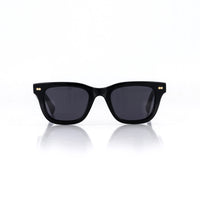
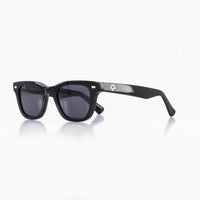
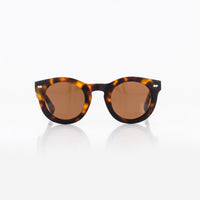
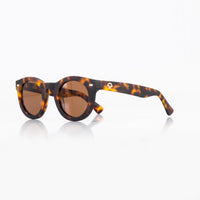
At Ballo, every single pair of sunglasses we make uses premium CR39 mineral glass lenses equipped with full UV400 protection.
What does UV400 actually mean?
It means the lenses are chemically engineered to block 100% of harmful UVA and UVB rays up to 400 nanometers. These invisible ultraviolet rays are the real villains of the solar system. Overexposure to them is directly associated with:
- Accelerated cataract development
- Long-term retinal stress and macular degeneration
- Photokeratitis (essentially a sunburn on your cornea)
A lens without UV protection, even if it is pitch black or polarized, allows those harmful rays straight through. In fact, wearing dark lenses without UV protection is actually worse than wearing no sunglasses at all, because the darkness causes your pupils to dilate, letting even more UV radiation flood into your eyes.
So, What Does Polarisation Actually Do?
If polarisation doesn’t protect your eyes from UV damage, what is it for? Visual comfort and clarity.
Light from the sun scatters in all directions. But when that light hits a flat surface, like the ocean, a tarmac road, a car bonnet or wet pavement, it reflects horizontally. This creates that harsh, blinding white light we know as glare.
A polarized filter acts like a microscopic Venetian blind. It only allows vertical light through, effectively cutting out that harsh horizontal glare.
The Benefits of Polarisation:
- Reduced Eye Fatigue: Your eyes don't have to squint or strain against intense reflections.
- Enhanced Contrast and Colour: Colours look richer and more saturated because they aren't washed out by white glare.
- Safety and Performance: If you spend a lot of time driving, fishing, sailing or spending time around water, polarisation lets you see right through the surface reflection.

The Golden Rule: Protection First, Comfort Second
To put it simply:
- A polarized lens without UV protection can still allow harmful UV rays to damage your eyes.
- A UV400 lens without polarisation still gives your eyes complete, absolute UV protection.
At Ballo, we focus first and foremost on protecting your eyes properly. That’s why we craft our lenses from high-quality CR39 optical material with total UV400 protection. But we didn't stop there.
To bridge the gap between protection and comfort, all our lenses also feature an anti-reflective coating on the inside of the lens.
When the sun is behind you, light can bounce off the back of your sunglass lenses and reflect straight into your eyes. Our anti-reflective coating bounces that light away, dramatically reducing eye strain and making them incredibly comfortable to wear, even in the brightest conditions, without relying solely on a polarised filter.
How to Choose Your Next Pair
The next time you’re investing in a pair of sunglasses, don’t just ask, “Are they polarized?”
Ask the deeper question: “Do they actually protect my eyes?”
At Ballo, you don't have to guess. Every single pair of our sustainably crafted frames comes standard with high-quality CR39 lenses that guarantee 100% UV400 protection and zero visual distortion. We’ve already done the hard work of sourcing the best eye protection on the planet, so all you have to do is choose the style that fits you best.
We believe good design should do good too. Looking good when you step outside is great, but protecting your eyes so you can enjoy the view for the next 30 years? That’s even better.


 Watch the film

